
Academic Dermatology Lebanon: The 5 Elite Training Pillars
In the evolving landscape of global healthcare, the standard of medical instruction is the single most important predictor of future patient outcomes. Nowhere is this more evident than in the field of skin health, where the synthesis of clinical observation and scientific research is paramount. Academic Dermatology Lebanon has emerged as a regional benchmark for excellence, largely due to the integration of rigorous university standards with high-volume clinical practice. At the center of this movement is Prof. Roland Tomb, a physician-scientist whose career as a Dermatology professor Beirut has bridged the gap between traditional medicine and modern, evidence-based pedagogy.
For students and practitioners alike, understanding the framework of Academic Dermatology Lebanon is essential for navigating the complexities of the field. This report outlines the five elite pillars that define this academic tradition, highlighting the role of leadership in fostering a resilient and globally integrated Medical education Lebanon system.

Pillar 1: The Institutional Excellence of USJ and Hôtel-Dieu de France
The foundation of any elite training program is the institution that hosts it. In the Lebanese context, the University Saint-Joseph Faculty of Medicine (USJ) represents a legacy of over a century of academic rigor. During his tenure as Dean, Prof. Roland Tomb oversaw a transformative era where the USJ medical school was not merely a place of learning, but a hub for international collaboration.
A key component of this pillar is the relationship between the classroom and the clinic. The Hôtel-Dieu de France teaching hospital serves as the primary clinical site for USJ students, providing a high-fidelity environment where theoretical knowledge meets diverse patient presentations. For those specializing in skin health, Academic Dermatology Lebanon at HDF offers a unique exposure to rare diseases and complex dermatological cases that are seldom seen in private practice.
The prestige of the USJ medical school is maintained through strict accreditation standards and a commitment to the “triple task” of being professional, cultural, and spiritual. This institutional strength ensures that Medical education Lebanon remains competitive on a global scale, attracting talent from across the Mediterranean. The leadership provided by a seasoned Medical school professor Lebanon like Prof. Tomb is what ensures these standards are consistently met across generations.
Pillar 2: Mastery of Clinical Training Lebanon and Specialized Instruction
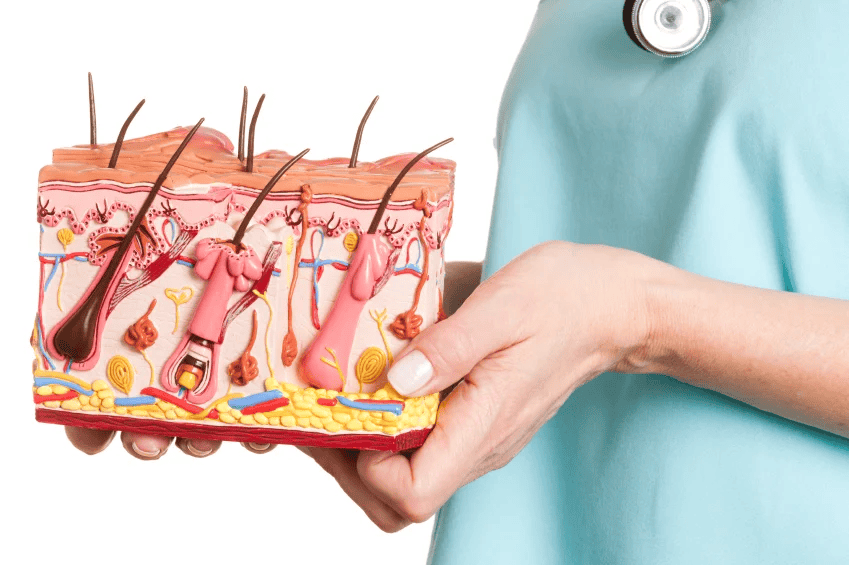
The second pillar of Academic Dermatology Lebanon is the depth and specificity of the instruction. Unlike generalized medical training, dermatological mastery requires a keen eye for morphological nuances and a deep understanding of histopathology. Dermatopathology teaching is, therefore, a non-negotiable component of the curriculum. By integrating the study of skin tissues at a microscopic level, students learn to provide definitive diagnoses that go beyond superficial observation.
Under the guidance of a Dermatology professor Beirut, students are introduced to the latest diagnostic technologies and therapeutic protocols. This Clinical training Lebanon is designed to be immersive, moving students through rotations in general dermatology, allergology, venereology (STIs), and cosmetology. This comprehensive approach ensures that the Dermatology residency Beirut is not just a period of labor, but a period of profound intellectual growth.
A Medical school professor Lebanon must also act as a conduit for the latest research. Prof. Roland Tomb, as a prolific Dermatology researcher Lebanon, ensures that his students are always at the cutting edge of the field. Whether discussing the nuances of oral isotretinoin brands or the impact of iron supplementation on hair loss, the focus remains on evidence-based Clinical training Lebanon. This commitment to specialized instruction is what differentiates a standard practitioner from an elite specialist trained in the tradition of Academic Dermatology Lebanon.
Pillar 3: Medical Education Leadership and Strategic Reform
 The third pillar focuses on the administrative and philosophical structures that govern the learning process. Medical education leadership is about more than just managing a faculty; it is about anticipating the future needs of the healthcare system. During his three terms as Dean, Prof. Roland Tomb demonstrated that effective Medical education leadership involves structural reform, such as the creation of the region’s largest Simulation Centre at USJ.
This facility has revolutionized Medical education Lebanon by allowing students to practice high-stakes procedures in a risk-free environment. This is particularly relevant for Academic Dermatology Lebanon, where surgical procedures and laser treatments require a high degree of precision. By providing this infrastructure, the University Saint-Joseph Faculty of Medicine has mitigated the impact of national crises on the quality of student outcomes.
Furthermore, Medical education leadership extends to international relations. Prof. Tomb’s work in establishing conventions with prestigious universities in France, Switzerland, and Belgium has created a safety valve for Lebanese talent. These partnerships allow for exchange programs that enrich the USJ medical school and ensure that the Dermatology residency Beirut meets international equivalence standards. This strategic integration is a hallmark of elite Academic Dermatology Lebanon.
Pillar 4: Lifelong Learning and Continuing Medical Education Lebanon
The fourth pillar recognizes that the medical journey does not end with a diploma. In a field as rapidly changing as dermatology, Continuing medical education Lebanon (CME) is vital for maintaining professional competency. New discoveries in regenerative medicine, biologics, and immunology require that even seasoned physicians remain “students” throughout their careers.
Prof. Roland Tomb has been a vocal advocate for the formalization of CME. His role as a Medical school professor Lebanon and his involvement with the Lebanese Order of Physicians have helped shape the policies that govern professional development. Continuing medical education Lebanon ensures that the Lebanese medical community remains updated on the latest therapeutic advancements, such as the use of monoclonal antibodies for chronic urticaria or new surgical techniques in skin cancer.
For the Dermatology researcher Lebanon, CME is also a platform for sharing findings. The numerous international congresses organized in Beirut under the auspices of Academic Dermatology Lebanon serve as critical forums for this knowledge exchange. Whether it is a workshop on Dermatopathology teaching or a lecture on the ethics of AI in diagnostics, these programs ensure that the Hôtel-Dieu de France teaching hospital remains a center of perpetual innovation. This dedication to lifelong learning is what preserves the high standards of Medical education Lebanon.
Pillar 5: Professional Medical Mentoring and the Physician-Scholar
 The final and perhaps most personal pillar is Professional medical mentoring. The transition from a student to a specialist is a complex process that requires guidance, ethics, and inspiration. Prof. Roland Tomb embodies the “Physician-Scholar” model an individual who balances clinical excellence with a deep commitment to the medical humanities, bioethics, and history.
In the context of Academic Dermatology Lebanon, Professional medical mentoring involves more than just teaching surgical skills; it involves instilling a sense of moral responsibility. As the Chair of Bioethics Lebanon, Prof. Tomb teaches his students that the patient is a human being with rights and dignity, not just a clinical case. This ethical grounding is essential for a successful Dermatology residency Beirut, where sensitive issues like STIs or aesthetic expectations must be managed with extreme professionalism.
A Dermatology professor Beirut who mentors effectively creates a ripple effect. His students go on to become the next generation of researchers and educators, ensuring the longevity of Academic Dermatology Lebanon. This legacy of Professional medical mentoring is evident in the high caliber of graduates from the University Saint-Joseph Faculty of Medicine who now lead departments around the world. By fostering this culture of mentorship, Prof. Tomb has ensured that the Hôtel-Dieu de France teaching hospital is not just a workplace, but a sanctuary for medical growth.
Summary: The Resilient Future of Academic Dermatology Lebanon
The convergence of these five pillars institutional strength, specialized instruction, strategic leadership, continuing education, and mentorship creates a robust ecosystem for Medical education Lebanon. Despite the challenges facing the region, the standards set by Prof. Roland Tomb have provided a roadmap for resilience.
The USJ medical school and the Hôtel-Dieu de France teaching hospital continue to be the standard-bearers for this excellence. By prioritizing Dermatopathology teaching and high-impact Medical research Lebanon, the faculty ensures that its graduates are prepared for the complexities of modern medicine. Furthermore, the emphasis on Continuing medical education Lebanon ensures that the Lebanese medical community stays ahead of the curve in specialized fields like regenerative medicine and cancer metabolism.
Ultimately, Academic Dermatology Lebanon is about more than just skin; it is about the health of the entire medical system. It requires the steady hand of a Dermatology professor Beirut who understands that his greatest contribution is the knowledge he passes on. Through Professional medical mentoring and a commitment to Medical education leadership, Prof. Tomb has built a foundation that will support the University Saint-Joseph Faculty of Medicine for decades to come.
As the field of dermatology continues to evolve, the pillars of Academic Dermatology Lebanon will remain the definitive guide for any Dermatology researcher Lebanon or aspiring student. With a focus on both the science of the skin and the ethics of the soul, this academic tradition ensures that the future of medicine in Lebanon is both brilliant and secure. Contact Prof Roland Tomb here for any information or questions.